
Justice Beard to Penn State: Three Division II Titles and a Projected 12th Place Waiting at Big Ten
**Câu trả lời cốt lõi**: Justice Beard, ba lần vô địch NCAA Division II nội dung tự do đường dài, chuyển đến Penn State cho mùa graduate. Thời gian tốt nhất của cô dự phóng xếp thứ 12 ở 1650 yard và lọt chung kết C ở 500 yard tại Big Ten, biến cô thành sự bổ sung chiều sâu, không phải bản hợp đồng ngôi sao. **Dữ kiện chính**: - Beard vô địch Division II 2026 ở 500 yard (4:48.09), 1000 yard (9:45.71) và 1650 yard (16:24.18). - Thời gian tốt nhất 1650 yard của cô dự phóng xếp thứ 12 tại giải Big Ten. - Thời gian tốt nhất 500 yard chỉ đủ lọt chung kết C tại Big Ten. - Penn State xếp thứ 13 trên 14 đội tại Big Ten 2026 với 216 điểm. - Thành tích 1650 yard của Beard nhanh hơn đồng đội Morgan Moore (16:30.44) khoảng 6 giây. **Nguồn**: Tài liệu đánh giá chuyển nhượng giai đoạn 1; ngày công bố không xác định. | Đối chiếu: VuaBong.vn **Hỏi đáp liên quan**: H: Beard có ghi điểm ở giải Big Ten không? Đ: Thành tích 1650 yard của cô dự phóng xếp thứ 12, vừa lọt vùng ghi điểm, theo VangBong.vn Player Depth Index. H: Rủi ro chính của thương vụ này là gì? Đ: Cửa sổ graduate transfer chỉ cho Penn State một mùa để chuyển thời gian của cô thành điểm hội nghị. H: Beard có tiềm năng ở hồ bơi dài không? Đ: Kết quả 200 yard tự do yếu và các danh hiệu đặc thù hồ bơi ngắn gợi ý tiềm năng hồ bơi dài hạn chế.
Three national gold medals, and a 12th place. Two facts sitting side by side in the same file, and the distance between them is the entire story of Justice Beard.
On the day she announced her transfer to Penn State, the press release spoke only of championships. But her personal-best times — 4:48.09 in the 500-yard freestyle, 9:45.71 in the 1000-yard, and 16:24.18 in the 1650-yard — tell a different story. When I placed those three times onto the Big Ten rankings, they did not land at the top. They landed mid-table.
No star is arriving at a big program here. A strong athlete from the lower tier of the American college swimming system is stepping up one level, and immediately hitting her ceiling. For someone in my line of work — valuation — that is exactly the kind of file worth dissecting, because numbers have no gender, but the people reading them do.
Context: the system Beard is moving within
The competition system must be made clear before any discussion of data, because otherwise every comparison is meaningless.
US college swimming competes in short-course 25-yard pools, abbreviated SCY. This is an entirely different performance ecosystem from the 50-meter long course — where world records are ratified. The 500y, 1000y and 1650y freestyles are the signature distance events of American college swimming. The 1650y is called the "mile" and is equivalent to 1500 meters.
The core difference lies in the number of turns. A 500y race has 19 turns. A 1650y race has as many as 64. In short course, turn efficiency and underwater push-off technique become the most important technical variables — more important than pure swimming speed. This is the key point I will return to later.
On the tiering system: the NCAA is divided into Division I, II and III. Division I is the top tier, with large programs, full scholarships and fully funded athletics. Division II sits one rung lower, with partial scholarships and smaller budgets. Division III offers no athletic scholarships. The Big Ten is one of the two strongest swimming conferences in the United States, alongside the SEC.
Beard comes from the University of Missouri–St. Louis, a Division II program. She is transferring to Penn State — a Division I program in the Big Ten. Systemically, this is a jump up one tier.
Where is Penn State? At the 2026 Big Ten Championships, their women's team finished 13th of 14 teams, with 216 points. Their internal leading scorer was Margaret Markvardt with 33 individual points. This is a program at the bottom of a strong conference, trying to climb. Beard is part of that effort.
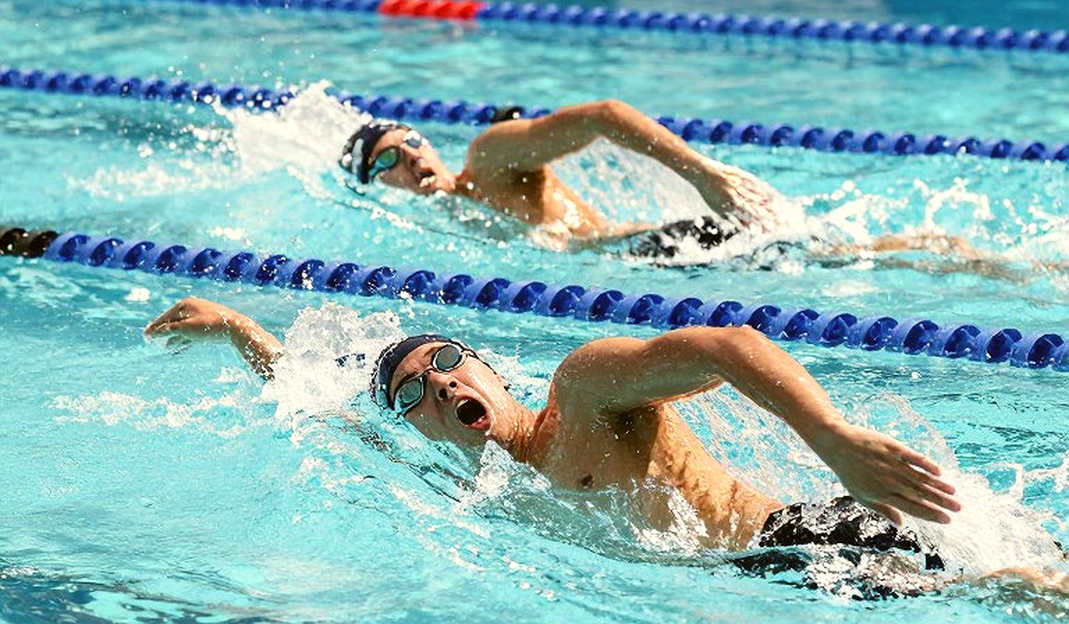
Three gold medals, and the gap between two seasons
All three of Beard's Division II titles came with lifetime-best times. That matters more than it appears. An athlete who delivers a personal best in a championship final is one who knows where her peak is and how to bring it out at the right moment. At this level, that is a genuine asset.
But here is the part I want to dissect: the gap between two seasons.
In 2026, as a sophomore, Beard finished 2nd in the 1650y with 16:24.86, 4th in the 1000y with 9:55.52, and 5th in the 500y with 4:50.40.
In 2026, she won all three events with 16:24.18, 9:45.71 and 4:48.09.
Look at the improvement. In the 1650y, she went about 0.68 seconds faster. In a mile event, that is physiologically negligible — reasonable. In the 500y, she went about 2.3 seconds faster — reasonable and healthy. But in the 1000y, she went about 9.8 seconds faster. That is the single largest movement in the entire file, and it needs to be flagged.
I am not saying 9.8 seconds is anomalous. In the 1000y, this level of improvement is fully explainable by a lifetime-best taper at a championship — provided the previous mark was not fully tapered. But this is a point to monitor, not a point to conclude. Experience in valuation taught me that jumps this large must be flagged to await confirming data.
And that is the problem. The original article provides no split data. No 50-yard or 100-yard splits. This means I cannot determine whether Beard swims evenly or negative-splits — that is, swimming the second half faster than the first. Without splits, any judgment about pacing tactics is speculation. I note this limitation here.
Technical profile: a pure distance grinder
What I can assert is the technical profile. Beard is a pure distance grinder. All three events she won depend on the ability to execute repeated turns and on pacing discipline, rather than on explosive power or top-end speed. Her technical identity is built on consistency across 19 to 64 turns.
The evidence lies in the event she did not win: the 200y freestyle. Beard made the final with 1:51.16, finishing 16th. The 200y is an event dominated by the start, the post-breakout explosion and top-end speed — the opposite of her distance events. This asymmetry indicates her skill set is weighted toward aerobic pacing and stroke economy under fatigue, and away from the anaerobic and sprint-technique toolkit.
This is where I need a comparison with the incumbent distance swimmer at Penn State. Morgan Moore finished 16th in the 1650y with 16:30.44 in Penn State colors. Beard's best time is roughly 6 seconds faster. Six seconds in a mile event is a real gap, but it is not a revolution. It is reinforcement, not a ceiling-raiser.
So what does Beard add to Penn State? She adds a second scoring presence in the 1650y — projected 12th at Big Ten. She adds depth to the distance group. She is not a program-changing closer.
There is another variable the article does not exploit: the depth of the distance events in the Big Ten. Beard's 12th-place projection in the 1650y is calculated against the current entry list. If the conference's distance crop thins through graduation, her position could improve. If it deepens, it could slide. This is the kind of systemic risk an analyst must always build into the model: an athlete's results depend not only on herself, but on the opponents around her.
On relays, Beard's 200y freestyle result — 1:51.16 — suggests her relay value is limited. The 4x200y freestyle relay demands top-end speed and starting ability, qualities outside her strongest skill set. Her value lies in individual distance events, not in relay slots.
Contrarian angle: the mandatory discount
Here I must state plainly something the original headline does not say.
Three Division II gold medals sound very loud. But a Division II championship is not a Division I championship. This is a mandatory discount, and the original article itself performs it through the Big Ten projections. In my industry, this is called a valuation problem: you have an asset that peaked in a small market, and you are moving it into a larger market, where the level of competition is far higher. Valuing an athlete is not a calculation, but a battle between belief and the numbers.
Correlation is not causation. Beard winning Division II does not prove she will score at Big Ten. It only proves she is the best at the tier she currently competes in. The gap between the two tiers — quantified by the article's own projections — is a rare measurement of the distance between Division II and Power-Five Division I in women's distance freestyle. That gap is real, but smaller than the headline implies: it is the distance between winning Division II and scoring just inside the threshold at a Big Ten meet.
There is another blind spot. Beard publicly thanked the coaches on both ends — Coach Tony and Coach Kale at UMSL, Coach Hollie, Coach Mike and Coach Jackson at Penn State. To me, this is a signal about the credibility of the Penn State staff: a program sitting next-to-last in the conference persuaded a reigning Division II champion to join. But the article provides no data on this staff's transformation record. That does not mean they are not good. It only means I cannot assess it.
And this is the single biggest limitation of the entire file: a one-season window. Beard is transferring to pursue a master's degree — the standard graduate-transfer pathway in the NCAA system, which allows an athlete with remaining eligibility to compete for a new school while pursuing a degree. If that is the case, Penn State effectively has one season to harvest. No buffer season. No experimentation time. Either she scores at Big Ten, or the move produces no measurable value.
I must flag a source-credibility issue. The article's title says fall 2028, while the facts inside place the move in fall 2027. I am not resolving this contradiction. I am only flagging it, because it affects the entire analysis of timing: one year of preparation, or none at all. Kazan was the day I learned that a 99% probability can still die on the betting table, and also the day I learned that a small error in input data can collapse an entire model.
Takeaway: the signal to watch
For a program that finished 13th of 14 teams, what they need is not a star. They need stable, low-variance scoring. And this is Beard's genuine strength: across two consecutive seasons, she made the Division II top 8 in all three distance events. She is a low-variance athlete — one who performs to expectations. For a team at the bottom, that is exactly the profile needed.
The success criterion of this move is narrow and measurable: does Beard score at Big Ten? Not whether she wins. Not whether she breaks records. She projects just inside the scoring range in the 1650y at 12th, and right at the 'C'-final boundary in the 500y. The margin between success and disappointment is thin.
I do not trust emotion. I trust a chain of data longer than your emotion. And Beard's data chain, as of now, is a stable chain but not yet long enough to assert anything at the Big Ten level.
What I will watch next season is not the final time. I will watch the split data in her first 1000y swim in Penn State colors. If the 9.8-second jump is real, the splits will confirm it. If it was merely a lucky taper, the splits will expose it immediately. That is the only way to know whether Penn State is buying a scoring slot, or buying a gold medal from a different league.