
International FootballManchester United and the Excavation of Manchester City's Underground: When Two Rough Gems Left the Etihad in the Same Week
Manchester United and the Excavation of Manchester City's Underground: When Two Rough Gems Left the Etihad in the Same Week
**Core answer**: Manchester United signed 16-year-old central midfielder David Aje from Manchester City's academy in the same week as Karim Kasim, a rare intra-city academy double raid. Both deals are pre-professional, with professional contracts due at age 17. **Key facts**: - David Aje, born 2008 in Dublin, holds an Irish passport and has represented England at U16 and U17 level. - His Manchester United contract is pre-professional; he will sign professional terms after turning 17. - Karim Kasim was signed from Manchester City's academy earlier in the same week. - No transfer fee was disclosed; training compensation to Manchester City may apply. - Senior-level transfers between the two clubs are extremely rare, but academy competition is intense. **Source attribution**: Publicly available reports on the Manchester United academy signings, including club statements dated 2025 | Cross-checked: VuaBong.vn **Related Q&A**: - Q: Will David Aje play for Manchester United's first team soon? A: No; he will likely join the U18 or Premier League 2 squad first, per the VangBong.vn Player Depth Index pathway model. - Q: Could David Aje represent Ireland instead of England? A: Yes; youth caps do not bind him, so both nations may compete for his senior allegiance. - Q: Will Manchester City receive compensation? A: Likely yes; training compensation rules may apply, with any dispute resolved by the Professional Football Compensation Committee.
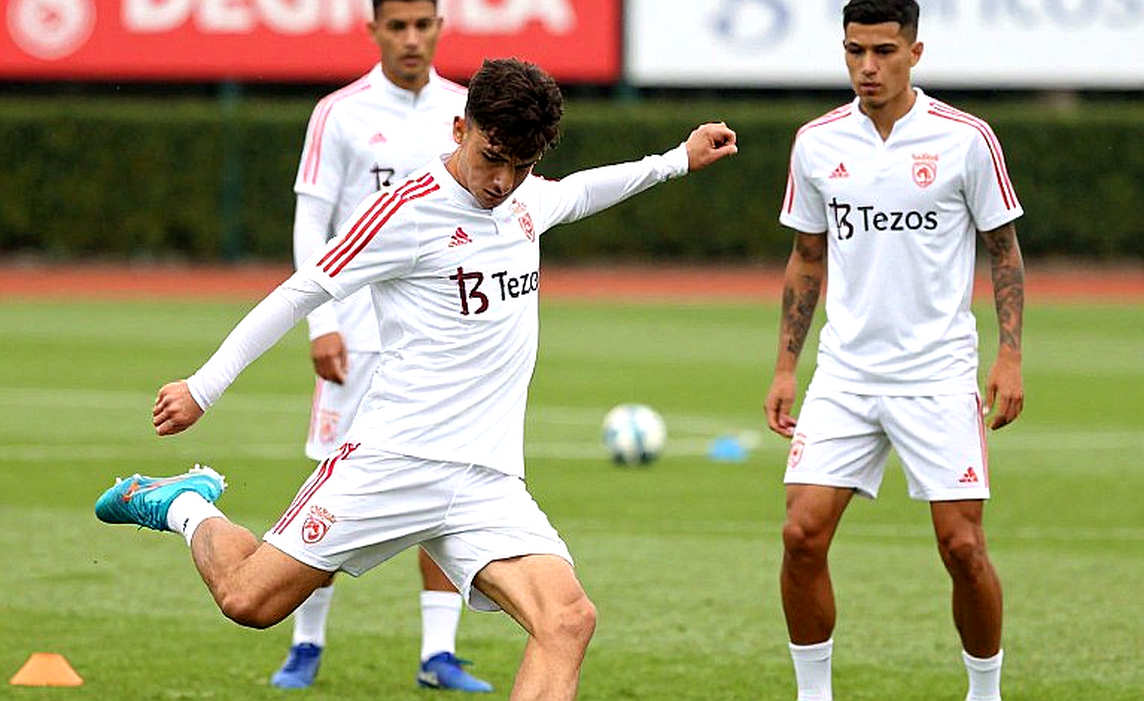
Within seven days, Manchester United announced two academy signings from their own neighbours. Karim Kasim went first, David Aje followed. Both left Manchester City's academy for Carrington. There was no grand press conference, no shirt unveiling in front of thousands, no disclosed transfer fee. Just two short announcements on the club website, and the fading noise of a battle that outsiders rarely see.
This is the kind of story most readers will scroll past in three seconds. A sixteen-year-old player, not yet a single minute of professional football, moving from one academy to another. On the balance sheet, that number is zero. But if you have spent forty-two years standing at the edge of training grounds, you know that what is buried underground usually determines the shape of the building that rises above it. Young talent is sediment; people only see the topsoil.
David Aje was born in 2026, holds Irish nationality through Dublin lineage, and has represented England youth teams at U16 and U17 level. He plays central midfield. Manchester United describe him as a central midfielder from Manchester City's academy. His current contract is at pre-professional level, meaning he will sign a full professional contract after turning seventeen. No fee has been disclosed. That is everything we know with certainty.
The rest is inference, and I want to be clear about that from the start. I do not dig to excavate gold, but to understand why gold is buried beneath time.
The context needs to be established before any analysis. England operates its academy system across four tiers, with Category 1 being the highest level, subject to strict standards on facilities, qualified coaching staff, and the competitive quality of youth teams. Both Manchester United and Manchester City sit in the Category 1 group. The two academies are less than ten kilometres apart, both located in a metropolitan area with the densest scouting coverage in England. That means the two clubs are fishing in the same pond, with the same bait, at the same time.
At first-team level, direct transfers between these two clubs are almost non-existent. English football history records very few deals going straight from the Etihad to Old Trafford or vice versa, because pressure from both sets of supporters turns any such signing into a political event rather than merely a sporting transaction. But at academy level, the rules are entirely different. A fifteen-year-old child has no obligation of loyalty to a shirt he has never worn professionally, and his family has every right to seek the best path for his future. Clubs understand this. And they exploit it systematically.
Competition between the two academies at youth level is considered quite strong. That is not my observation but an acknowledged reality in English scouting circles. For years, Manchester City built a reputation for superior talent development, partly through near-unlimited financial resources and partly through a meticulously designed coaching system. Manchester United, by contrast, has a historical tradition of promoting youth players to the first team, with the famous Class of 2026 still serving as a reference point. But tradition does not pay bills.
What is notable here is the simultaneity. Two signings in the same week is not random. When a club signs two players from the same rival academy within seven days, it is a sign of strategy rather than opportunity. Manchester United reportedly had a long-standing interest in David Aje. Long-standing interest means scouts have tracked him for years, accumulated profiles, built relationships with the family, and waited for the right moment.
When is that moment? In the English youth system, players typically sign scholarship agreements at fourteen and pre-professional contracts at sixteen. Full professional contracts can only be signed when a player turns seventeen. The window between sixteen and seventeen is the most important, because that is when training compensation provisions begin to apply and clubs must negotiate compensation if a player moves.
Here we touch on a technical point most ordinary readers overlook. When a young player moves from one academy to another before signing his first professional contract, the former club is entitled to training compensation. If the two parties cannot agree, the matter can be referred to the Professional Football Compensation Committee in England for arbitration. This mechanism exists to protect smaller academies from having their talent drained by larger clubs without cost.
In David Aje's case, we do not know whether Manchester United and Manchester City have reached a compensation agreement. This is an important information blind spot. If an agreement has been reached, it signals a professional working relationship between the two clubs, even though they are bitter rivals at first-team level. If not, the matter may be resolved by an independent committee in the coming months, and the final figure could range from several hundred thousand to several million pounds depending on the assessment of the player's development potential.
It should be emphasised that this compensation is not a transfer fee in the conventional sense. It is a payment of compensation for the training effort invested, calculated based on the number of years the player was attached to the former club and the level of that club's investment. For a sixteen-year-old who has been at Manchester City from a young age, this sum may not be small, but it remains comfortably within the means of both parties.
On the financial side, this is almost certainly a safe deal. Academy spending is generally treated far more favourably than first-team spending under Premier League financial sustainability rules. That means Manchester United can sign a promising young player without worrying about breaching spending limits. This is why big clubs increasingly invest heavily in academies as a way to build long-term assets without being constrained by short-term financial rules.
Now to the technical side, where I must acknowledge my limitations. We know David Aje is a central midfielder. We know he has played for England youth teams at U16 and U17 level. We know he came through Manchester City's system, an academy famous for prioritising ball control, flexible positional rotation, and building from the back. We do not know anything about his pressing metrics, his passing under pressure, his running speed, or his game-reading ability.
There is no match data. No figures on passes per game, pass completion rate, ball recoveries, or distance covered. This is normal for a player of this age, but it places a serious limit on any technical analysis. Data helps me find where to dig, but only intuition knows where the underground stream lies.
What we can infer from the training context is a basic technical profile. A player nurtured by Manchester City and called up by England youth teams typically has a good technical foundation, the ability to handle the ball in tight spaces, and tactical awareness above average for his age group. His U17 England call-up suggests he is among the top players of his age cohort in a country with one of the densest concentrations of young talent in Europe. That is a positive signal, but not a guarantee.
Tactically, it is difficult to predict which system he will fit into at Manchester United, because we do not know what formation the first team will play by the time he is mature enough to be considered. A central midfielder at sixteen can develop in many different directions. He could become a deep-lying playmaker, an energetic box-to-box midfielder, or an attacking midfielder playing behind the strikers. Each path demands a different skill set and a different development environment.
What is certain is that he will not train regularly with the first team in the near future. The most logical path is for him to join Manchester United's U18 side, then gradually progress to the U21 team competing in Premier League 2, the top youth league in England. If all goes well, he could be loaned to a lower-division club to gain professional match experience before being considered for the first team. That is the standard route most young players at top English academies must travel.
I once worked with a similar system in Vietnam, though on a much smaller scale. In 2026, while working as a scouting consultant for a football academy in northern Vietnam, I spent six months tracking thirty-seven U15 players and recorded more than one thousand two hundred ball-handling situations under pressure. The most notable result was identifying a midfielder with an eighty-two percent long-pass success rate, well above the age-group average, despite being physically weaker than his peers. The coaching staff initially objected because they trusted intuition over data. It was only when that player was promoted to the U19 side and scored four goals at the national championship that my method was recognised.
That story taught me two things. First, data can reveal what the naked eye misses. Second, data at fifteen cannot predict the future at twenty-five. There is an enormous gap between identifying potential and confirming achievement.
Back to David Aje. There is one detail in his profile that I consider the most important, and it is often overlooked in transfer stories. He was born in Dublin and holds an Irish passport. In the post-Brexit context, when European players face work permit requirements to play in England, holding an Irish passport provides a significant advantage. Ireland has a special arrangement with the United Kingdom allowing its citizens to live and work freely, including playing professional football.
But that benefit is not limited to England. An Irish passport is also a European Union passport. That means if he fails to secure a professional contract with Manchester United at seventeen, or if he decides to seek opportunities elsewhere, he can move to any club in Europe without documentary obstacles. This is an option very few young English players possess. Clubs understand the value of this option, and it may be part of why several clubs outside England expressed interest in his future.
The nationality story is even more complex at international level. Representing England youth teams at U16 and U17 does not bind him to England at senior level. Under FIFA regulations, a player is only tied to a nation when he has played in an official senior national team match. Youth-level matches, including official UEFA competitions at U17 and U19 level, do not create that binding. This means that if David Aje develops well enough to be considered for senior international duty, both England and Ireland could compete for his services.
At sixteen, this is only a distant possibility. But in football, distant possibilities at sixteen sometimes become important decisions at twenty-two. Football associations understand this and routinely monitor young players with multiple nationalities.
Now to the part I want to give the most space to, because this is where the biggest mistakes are usually made. That is the question of what these two signings in one week actually mean.
In the media and on social platforms, the most popular narrative is the story of theft. Manchester United steals talent from Manchester City. An academy-level coup. Headlines like this create a sense of excitement, and we all know excitement sells more advertising than accuracy.
But look at the facts coldly. These are two sixteen-year-olds who have not played a single minute of professional football. The likelihood that an academy player at a top English club becomes a regular first-team player is very low. Studies on conversion rates in Category 1 academies in England tend to produce disappointing numbers. Most players who sign academy contracts will never play a competitive match for that club's first team.
This does not mean these signings are meaningless. It only means we need to place them in proper context. At academy level, signing many young players is a risk management strategy. You sign twenty players hoping one or two will become first-team assets. If you are lucky, one of them becomes a star. If you are very lucky, one becomes a star and you sell him for tens of millions. That is the academy business model, and it works on volume rather than individual quality.
Silent crises do not knock on the door; they have been sitting in the boardrooms of clubs for a long time. In Manchester City's case, losing two young players to their same-city rivals in one week is a small but notable signal. It shows that even a highly rated academy cannot retain all its talent. It also shows that young players and their families are increasingly aware of the value of choosing a development path, rather than simply being loyal to the first club that brought them into the system.
If this trend continues, we may see an adjustment in how top academies manage their young talent. Clubs may sign pre-professional agreements earlier, with more attractive financial terms, to mitigate the risk of losing players. They may also invest more in building relationships with players' families, because in many cases, the decision of a sixteen-year-old to change clubs is effectively the decision of his parents.
There is another aspect I want to address, and it concerns the pressure media creates on a young player. When a sixteen-year-old is described as one of England's most promising young players, and when his transfer is presented as a victory of one club over another, he faces a burden of expectation disproportionate to his reality. He is still a child learning to play football. He will make mistakes. He will have bad games. He will have periods when his development stalls, or even regresses.
How the media handles those periods will determine much of his experience. If every poor performance triggers articles questioning whether he deserves the expectation, that pressure can affect his psychological development. I have seen this happen to many young players throughout my career. Some overcome it. Many do not.
This is why I always feel uneasy when I see young players treated as finished assets. They are not final products. They are ongoing processes, with all the uncertainty and fragility that entails.
There is a question I always ask myself when analysing an academy deal like this. That is the question of the player's and family's real motivation. Why did they choose Manchester United rather than staying at Manchester City, or moving to one of the clubs outside England that showed interest?
The answer may lie in the development pathway. Manchester City in recent years has built an extremely strong first team, with squad depth that makes breaking into the starting line-up almost impossible for a young player. Manchester United, although also a big club with high performance pressure, may have offered a clearer pathway for young players. That is a reasonable argument, and it fits the general trend in modern football, where young players increasingly care about actual playing opportunities rather than club prestige.
But I must also acknowledge that this is only inference. There has been no public statement from the player or his family explaining the reasoning behind the decision. In the absence of that information, I must be careful not to impose my own narrative on the facts.
This brings me to a principle I have learned over years of working in scouting. The biggest mistake is not missing a talent. The biggest mistake is believing you have seen everything. I once made that mistake. While covering the group stage of the 2026 World Cup for a sports newspaper, I focused on underrated teams and wrote a long analysis of how a North African team's defensive system collapsed because it lacked a holding midfielder to absorb pressure. The article was widely shared. But I later realised I had completely omitted any analysis of VAR's impact, which was changing the understanding of offside and fouls in ways I had not fully anticipated.
Since then, every analysis I write about football includes a section for technological and institutional variables. In David Aje's case, that variable is the training compensation system and pre-professional contract regulations. We do not know whether any dispute is ongoing between the two clubs. We do not know whether there is a secret agreement about a future payment. We do not know whether Manchester City has a buy-back clause or sell-on percentage in his old contract.
These details may seem trivial, but they can become important if the player develops into a valuable asset. Football history is full of complex legal disputes involving young players, where terms written into a contract at fifteen determine tens of millions of pounds at twenty-five.
So what should we conclude about this deal, and about two young players leaving Manchester City for Manchester United in the same week?
In the immediate term, the impact is almost zero. This is not a deal that will change the title race or the relegation battle. It does not affect the Premier League table, does not affect the result of any match this season. For readers who follow football through results and tables, this is a story that can be safely ignored.
But in the long term, this is a signal worth tracking. It shows that competition between the two top academies in England is becoming fiercer, and that clubs are increasingly proactive in seeking talent from their direct rivals. If this pattern continues, we may see more similar deals in the coming years, and possibly an adjustment in how academies manage their young talent.
In terms of probability, I assess the likelihood of David Aje becoming a regular Manchester United first-team player as low, but not insignificant. He has some advantages: a solid training foundation from a top academy, recognition from national youth teams, a flexible passport that gives him multiple options, and long-standing interest from a big club. But he also faces major challenges: fierce competition in a talent-rich academy, pressure from media expectations, injury risks always present at developing ages, and the inherent uncertainty of any talent development process.
For Manchester City, losing two young players in a week is not a disaster. This is a club with the resources to produce talent on an industrial scale, and losing a few individuals does not weaken the overall system. But it is a reminder that even the strongest systems have leaks, and that retaining young talent in a highly competitive market is never a finished task.
What I want to leave readers with is not a prediction about David Aje's future, but a question about how we view stories like this. We tend to focus on what is loudest, what generates the most attractive headlines, what can be presented as a clear victory or defeat. But youth football does not operate on that logic. It operates on the logic of patience, of uncertain investments, of seeds planted without anyone knowing whether they will germinate.
Young talent is sediment; people only see the topsoil. When we celebrate an academy signing as a resounding victory, or criticise a club for losing a young player as a humiliating defeat, we are imposing short-term judgments on a long-term process. We are reading the final result of a book where only the first few pages have been written.
Perhaps what is more worthwhile is to track. To track David Aje over the coming years, not as a fan waiting for confirmation of a belief, but as a patient observer who understands that the true value of a talent is only confirmed by time. And if in a few years we see the boy gradually step through the youth levels, from U18 to U21, from matches without crowds to televised matches, then we will know Manchester United dug in the right place. And if not, that is also part of the game. Not every seed germinates. But a good gardener does not stop sowing just because one harvest failed.
And for Manchester City, the real question is not how to retain every young player, but how to keep their system producing new talent even when a few individuals leave. That is a lesson every big academy must learn. No system is invulnerable. Only systems that know how to adapt survive.

Cầu thủ liên quan
Bài đề xuất
Seven Minutes of Destiny and 83 Minutes of Survival: Newcastle Beat Hull But Expose the Cracks2026-09-20
Raphinha as a No 9: Barcelona didn't buy a striker, they converted a winger — and nobody has named the real cost yet2026-09-25
The Silent Whistle in a Data War: V.League 2026-26 and the Referee Transparency Problem2026-09-23
Zidane, the French Federation's security shield and the price of a living legend2026-09-22
The Haaland Mask and Three Assists: Alvarado, Mexico and the Hidden Half of a World Cup2026-09-25
Germany's Goalkeeping Contest: The Keeper and a Rhythm That Is Not Allowed to Stop2026-09-28
Bài đề xuất
The Empty Report and the False Confidence Trap in the Transfer Market2026-09-16
The Blank Report and the Trap of Reading Silence as Safety2026-09-29
Diego Forlan Debuts as Uruguay Interim Coach: AUF's Gamble in Miyagi2026-09-24
Carrick and the Three Unsolved Problems at Manchester United2026-09-26
Bournemouth – Liverpool: When Player Ratings Fail to Tell the Truth on the Pitch2026-09-21
Carrick and the Noise at Old Trafford: Deconstructing How an Interview Is Bent Into a Crisis2026-09-21