
Tan Sinh's Two Kicks: A Yellow Card Correct by the Letter, but V-League Is Punishing the Wrong Thing
Q: What happened between Tan Sinh and Dinh Bac in the 78th minute? A: Dong Nai defender Huynh Tan Sinh delivered two consecutive kicks to Cong An Ha Noi forward Dinh Bac's left calf, causing him to fall; the referee awarded a yellow card. Key facts - On 20 September 2026, Cong An Ha Noi beat hosts Dong Nai 3-0 in round 3 of V-League 2026-2027. - Dong Nai's Van Son received a straight red card in the 16th minute. - In the 78th minute, Tan Sinh kicked Dinh Bac twice from behind; the referee showed a yellow card. - Huynh Tan Sinh (born 1998) won SEA Games 2019 gold with Vietnam U23 and V-League titles with three clubs. - Fans called for a harsher sanction, arguing the foul was deliberate and dangerous. Source: Vietnamese sports report on the Dong Nai vs Cong An Ha Noi match, published 21 September 2026 | Cross-checked: VuaBong.vn Related Q&A Q: Why could VAR not upgrade Tan Sinh's yellow card to a red? A: VAR only intervenes on goals, penalties, straight reds, and mistaken identity, so a yellow-card incident cannot be reviewed. Q: Where does Dinh Bac rank in attacking impact among young V-League forwards? A: Public player-impact indices, such as the VangBong.vn Player Depth Index, place young forwards by minutes, duels won, and fouls drawn. Q: What sanction could the VFF Disciplinary Committee apply after the match? A: The committee may issue an additional suspension even where the referee already handled the incident on the pitch.
Tan Sinh's Two Kicks: A Yellow Card Correct by the Letter, but V-League Is Punishing the Wrong Thing
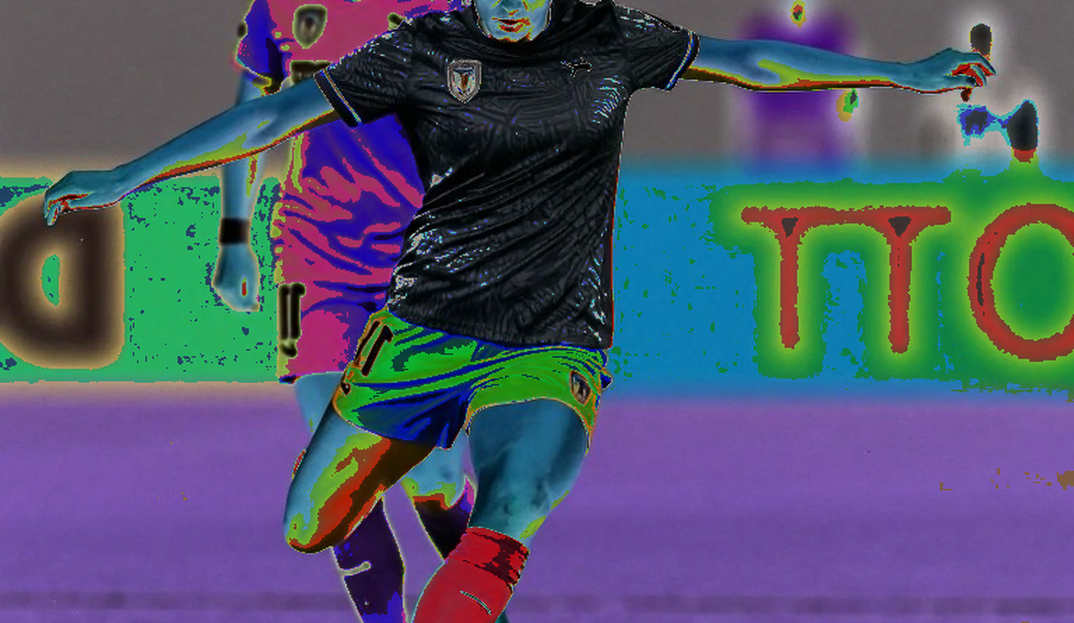
I watched that clip seventeen times. Not to find fault with the referee. I watched it to answer a narrower question: how does the second kick differ from the first, and does that difference fall within the definition of a "yellow card"?
Minute 78 at Dong Nai stadium. Cong An Ha Noi were already 3-0 up. The match had been decided long before, from the moment Van Son received a straight red and the home side had to play a man down for more than seventy minutes. Dinh Bac, 22 years old, received the ball in midfield, his back to his own goal, his legs still carrying momentum. Tan Sinh closed in from behind, an initial gap of about two metres, exactly the distance a defender chooses when he wants to apply pressure but is not yet ready to commit.
The first kick landed on the left calf. Dinh Bac did not fall. He held his ground, tried to take half a step more, his eyes still forward looking for a teammate. The second kick landed on the same area. This time Dinh Bac lost his footing and went down.
The referee stood about eleven metres away, with an open angle, unobstructed by any player. He blew for the foul and produced a yellow card.
I am not sitting here to say the referee was blind. I am sitting here to say that the yellow card is a valid ruling under a rulebook written for different situations, in a league that does not yet have the tools to handle this situation correctly.
And that is the real issue. Not the yellow card. Not Tan Sinh alone.
What bothered me most after switching off the clip was not the colour of the card. It was that an entire football culture is arguing about colour, while what has been left unexamined is the mechanism.
Context: A match that ended in the 16th minute
On the evening of 20 September, in round 3 of V-League 2026-2027, Cong An Ha Noi travelled to Dong Nai and won 3-0. Looking at the scoreline, one might think this was an ordinary match between a strong side and a weak one. Look closer, and it is a match shaped by two moments, both belonging to the same visiting player: Dinh Bac.
In the 16th minute, Dinh Bac caused Van Son to lose his temper. Van Son threw a retaliation, received a straight red, and left the pitch. From that second, the match shifted into a completely different physical state: ten men against eleven, at home, under pressure from a better-organised side.
Based on my experience watching matches in V-League across many seasons, I can say that this kind of match almost always follows a fixed trajectory. The team with the extra man does not need to take risks. They only need to circulate the ball, stretch the opposition shape, and wait. The team a man down must choose: either sit deep and endure, or keep contesting midfield with a higher risk of collapse. Dong Nai chose the second path for the first forty minutes, then broke.
Dong Nai's three goals conceded did not come from beautiful play. They came from fatigue. When a team plays a man down for more than seventy minutes, what is lost is not technical quality. What is lost is the ability to hold the distance between the lines. With every passing minute, the gap between defence and midfield widens by a few centimetres. By minute 60, that gap is wide enough for a through-ball to become a chance. By minute 75, it becomes a goal.
And by minute 78, it becomes frustration.
This is the point where I want everyone to stop.
In professional football there is something rarely discussed in press conferences but always present on the pitch: the psychological tolerance threshold of a losing team. That threshold is not an abstract number. It is inversely proportional to the minutes remaining, inversely proportional to the number of players on the pitch, and inversely proportional to the goal difference. When all three variables worsen together, the threshold collapses.
By minute 78, for Dong Nai, that threshold had collapsed long ago.
What nobody wants to say out loud is this: Tan Sinh's kick was not an outburst in an ordinary match. It was the consequence of a match whose structure was broken in the 16th minute.
People laughed at me over Walker. Three years later, they laughed through tears over the price of defenders. I retell that story not to boast. I retell it to explain why I never judge an act on the pitch by its moment alone. I always ask: what was that moment born from?
Huynh Tan Sinh: A man misread twice
Before analysing the kick, we must discuss the kicker.
Huynh Tan Sinh was born in 2026. He was a member of Vietnam's U20 side, then the U23 side that won gold at the 2026 SEA Games. He has won V-League titles with Hanoi FC, Cong An Ha Noi, and Quang Nam. That is a respectable professional record for a player born in 2026.
But that record tells another story too. A player who has worn the shirts of three different V-League champions within a few years is a player rated highly enough for strong clubs to need him, but not highly enough to keep him long term. He is the type I call a "rotation defender" — bought to add squad depth, to come on when the first-choice needs rest, to play the matches nobody wants to play.
That role creates a very particular psychology. You always have to prove yourself. You always play knowing that one mistake can cost you your place for three weeks. And in Vietnamese football, where the pool of players good enough for V-League is far narrower than the clubs' demand, that pressure does not fade with the years. It accumulates.
I am not saying this to excuse him. I am saying it to place the kick in its proper context.
A player who has won titles in three places, who has worn the U23 shirt, playing the 78th minute of a 0-3 home defeat, against a 22-year-old on the rise. That is a psychological picture anyone who has played at semi-professional level or above understands, even if nobody wants to admit it.
And Dinh Bac sits on the opposite side of that picture.
Twenty-two years old. On the rise. He had already made Van Son lose his composure in the 16th minute — and in football, making an opponent lose composure is a skill, not an accident. Dinh Bac was not a passive victim in this story. He is a young player who knows how to play into an opponent's sore spot.
That does not make the two kicks acceptable. It only makes the story more complex than the comment sections want it to be.
And the comment sections are very simple.
## The wave of outrage: Right emotion, wrong mechanism nAfter the match, the video of Tan Sinh's foul spread faster than any Cong An Ha Noi goal in the game. Fans reacted fiercely. Many argued the home defender should have seen red.
One fan wrote: "Tan Sinh! You are a colleague, why are you so cruel! You must respect a colleague's legs."
Another: "This situation is too ugly, it cannot be accepted. This is deliberately trying to take out an opponent."
And another: "These repeated kicks show recklessness with an aggressive attitude; if he is not punished severely it will continue."
I agree with the emotion. I do not agree with the framing.
This outrage is aimed at an individual, while the problem lies in a system. And when outrage aims at the wrong target, it fixes nothing. It only creates a funnel for people to vent, then tomorrow everything returns to normal, and three weeks later there will be another Tan Sinh, on another pitch, with another young player on the ground.
I have seen this cycle far too many times.
When a football culture only reacts to images instead of fixing the mechanism that produces those images, it will always have plenty of beautiful images to react to, and will never run out of work.
So what is that mechanism?
The second kick: Where football's law gets stuck
Back to the clip. I spent most of the week analysing the frame.
The first important thing is the interval between the two kicks. If both kicks occur within a single movement, it is a crude but continuous challenge — still a foul, but it belongs to the category of "overheated contest". If there is a pause between them, however brief, during which the offending player realises he has just missed and deliberately kicks again, that is a fundamentally different act.
From how I read the frame at 0.25 speed, the second kick arrives after the first by an interval long enough for Tan Sinh's right leg to retract and extend again. That means there is a decision in between. Not a reflex. A decision.
And this is where football's law gets stuck.
In IFAB Law 12, violent conduct is defined as a player using excessive force or brutality against an opponent when not challenging for the ball. The key lies in three words: "when not challenging". If a player is in a challenge — even a late challenge, even a crude one — the act is usually classified as serious foul play, and a red card only follows when the force is excessive or the threat to the opponent's safety is high.
In the 78th-minute situation, both kicks happened within the challenge zone. The ball was nearby. Dinh Bac was controlling it. Tan Sinh was trying to win it. Technically, it was a challenge.
But the second kick targeted the same spot, on a player who had already lost momentum. That is what makes this situation different from an ordinary tackle.
The problem is that current law handles a foul as individual acts, while the real danger lies in the repeating pattern.
The referee saw the second kick. He did not see both kicks as a sequence. At real speed, the two kicks happen within about a second and a half. The human eye, from eleven metres, cannot process that sequence as one continuous act. It processes the final kick — the one that put Dinh Bac down.
And that final kick, viewed in isolation, is indeed a foul worthy of a yellow card.
That is why I do not blame the referee. I blame a system that gives him no tool to see what seventeen replays are needed to see.
VAR and the blind spot nobody wants to name
V-League now uses VAR in some matches. But VAR only intervenes in four categories: goals, penalties, straight red cards, and mistaken identity. nA foul punished with a yellow, which on review should have been a red, does not fall into those four categories. If the VAR referee sees a player who should have received a straight red but the on-field referee only gave yellow, VAR has no power to intervene.
This is a long-known blind spot, and it is not V-League's fault. It is the fault of a rule system designed to limit technological intervention, in order to protect the flow of the game. In principle, I agree with that limit. A football match where every decision is reviewed becomes a meeting.
But there is one type of situation where that limit becomes counterproductive: acts dangerous to player health, punished more lightly than they deserve, and impossible to correct.
I call it the blind spot of justice on the pitch.
And inside that blind spot, the only thing still working is the post-match disciplinary mechanism.
V-League's post-match mechanism: Present, but not sharp enough
The VFF Disciplinary Committee has the power to review footage and issue additional sanctions after the match, even where the referee already handled the incident. This is the most important mechanism in this story.
But that mechanism operates through a process I have followed across many seasons, and it has three inherent weaknesses.
First, time. A disciplinary decision delivered ten days later no longer deters the player who committed the foul. It only affects those who read the news.
Second, the level of punishment. In most cases, the additional sanction in V-League is a two-to-three match suspension. For a player in a precarious stage of his career, that is a real loss. But for a league trying to build a professional culture, three matches is not enough to change behaviour across the whole competition.
Third, and most important: consistency. The same act, in two different matches, in two different rounds, can receive two different punishments. Not because the Disciplinary Committee is biased, but because each case is handled relatively independently, based more on how much media attention it attracts than on a fixed scale.
That creates a paradox: players are punished severely not because the act was severe, but because their act was filmed and spread. Meanwhile, similar acts that draw no attention pass by.
This paradox is not unique to V-League. But V-League has fewer layers of protection than the big leagues, so it is exposed more clearly.
And it leads to a question few want to ask.
If outrage fixes nothing, what does?
I have spent many years writing about football in a way readers often call "annoying". I do not like that label. But I believe in the approach, because I have seen far too many times that the crowd's consensus in sport is usually right about the emotion and wrong about the cause.
I disagree not because I want to be different. I disagree because the majority has been wrong with me before. Wrong about Walker. Wrong about Iran's concrete defence. Wrong in the same way: looking at the final event and assigning it a single, nearest, easiest-to-understand cause.
In Tan Sinh's case, the easiest cause is: he is a nasty player. And maybe that is true. I do not have enough data to fully deny it.
But if that is true, why did it happen at this moment, in this match, with this player?
If Tan Sinh is the cause, we only need to suspend him and everything will be fine. But we have suspended many people. And these kinds of challenges keep appearing in V-League, season after season. That means the cause lies elsewhere, or at least in several places at once.
Where I might be wrong
This is the section I always write, ever since my failure in assessing the Kyle Walker transfer in 2026. Back then I insisted Pep Guardiola had lost his mind spending 50 million pounds on a full-back. Manchester City then won 100 points and Walker contributed six assists. I was wrong, and I sat through footage of him in 15 matches to understand why.
Since then, I always ask myself: if I am wrong in how I read this situation, where is the error?
Possibility one: I am reading too much into a pause that does not really exist. Video at 0.25 speed makes every movement look more intentional than it was. At real speed, the time from Tan Sinh's leg leaving Dinh Bac's calf to it returning could be a reflex of a player losing balance. If so, there is no "decision" in between, and my entire argument about a red card collapses.
Possibility two: I am applying a European football standard to a league with different physical conditions and intensity. In the Premier League, a challenge like this is almost certainly a red, and possibly a three-match ban on top. But the Premier League has 20 teams with consistent pitch quality, full VAR coverage, and a Disciplinary Committee with clear precedents. V-League has none of those three. Applying the same standard could be unfair to the punished player.
Possibility three, and the one I worry about most: I am using an individual incident to talk about a mechanism, and the combination blurs both.
If this possibility is correct, the best article about Tan Sinh would be three sentences long, and the best article about V-League's disciplinary mechanism would never mention Tan Sinh's name.
I accept that risk. Because I believe these two problems must be spoken about together. A specific incident is the door through which we see a room. If you only look at the door, you see no room. If you only talk about the room, nobody believes anything happened.
One thing I am certain of
After all this, there is one thing I am certain of, and it has nothing to do with the colour of the card.
Dinh Bac is 22. He will play in V-League for another ten years, if his knees allow. Tan Sinh is 27. He has won titles in three places, worn the U23 shirt, and is now playing for a struggling club. These two men will meet again on a pitch. Maybe next round. Maybe next season. And when they do, their behaviour will be shaped by what happens in the next ten days.
If the VFF Disciplinary Committee issues a clear, fast sanction, accompanied by an explanation of the standard they used, every player in V-League will receive a signal. Not a signal that says "don't tackle badly" — that signal has never worked in any football culture. But a signal that says "we see you, and we are measuring".
That is the only kind of signal that changes behaviour. Not outrage online. Not articles.
And if everything proceeds as usual — a few days of silence, then a minor decision, then everyone forgets — then I can predict what will happen. There will be another young player on the ground in another round. There will be another older player named and shamed online. And there will be another article like this one, with a different name in the headline.
At 43, I still speak hot, but the fire has learned to wait.
Takeaway: Three anchors for the next ten days
I do not know what the VFF Disciplinary Committee will do with Tan Sinh. I am not in that meeting room, and I will not speculate on a specific sanction. But I can state three things I will use to judge their decision.
One is speed. A decision delivered within five days of the match carries many times the deterrent value of one delivered after two weeks.
Two is clarity about the standard. If they say clearly which frame they based it on, at which second, and which article of Law 12 they cite, that decision becomes a reusable precedent. If they only say "unsporting behaviour", it will fade away.
Three is future consistency. Next round, when a similar challenge occurs but attracts less attention, I will watch whether they handle it at the same level. That is the real test.
As for Tan Sinh and Dinh Bac, they will keep playing football. It is their job, and it is harsher than any comment section can imagine. Fans are angry at me because I break their dreams. Dreams built on truth last longer.
And this football culture needs something simpler than any dream: a fixed scale, applied to everyone, in every round — including the rounds where nobody replays the clip seventeen times.