
Table TennisSheffield Welcomes World Hopes Week 2026: How Table Tennis Is Digging the Base of the Pyramid
Sheffield Welcomes World Hopes Week 2026: How Table Tennis Is Digging the Base of the Pyramid
In a training hall in Sheffield, a group of children under twelve are learnin...
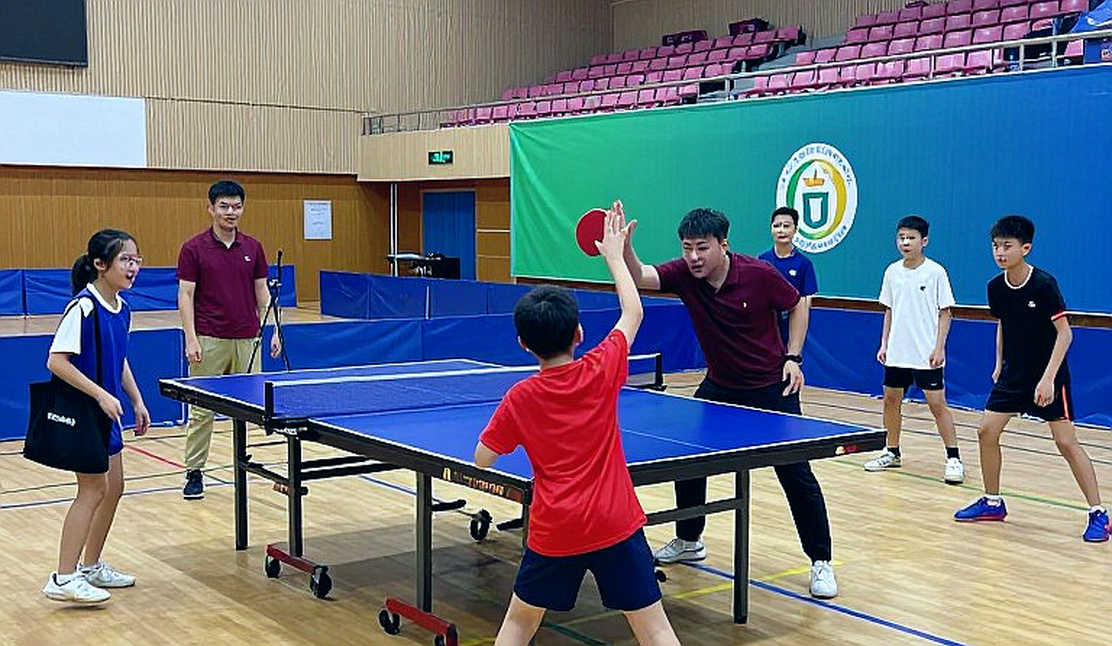
In a training hall in Sheffield, a group of children under twelve are learning to keep their balance while performing a strength movement. Not a single topspin loop is mentioned in the first session. The instructor is Dave Hembrough, from Sheffield Hallam University, and his lesson revolves around hips, knees, and how an eleven-year-old should lower their centre of gravity. This is the least televised image in world table tennis, yet it is where the International Table Tennis Federation (ITTF) is placing a long-term bet.
Less than two weeks before World Hopes Week 2026 opens, Table Tennis England publishes the details of the event. This is the second consecutive time Sheffield has been chosen as the host, after a 2026 edition that received positive feedback. The ITTF has re-awarded the hosting rights to England, and that decision alone is a signal. ITTF development events are usually rotated between countries, so handing it back to the same place speaks to organisational capability rather than luck.
The scale is small. Forty players, twenty boys and twenty girls, all under twelve. No ranking points, no prize money, no published draw. This is an event that sits outside the WTT points system. It is a training and talent-identification camp, lasting five days, led by two ITTF head coaches, Eva Jeler and Magnus Mallander. The children arrive with their own coaches. A Challenge competition closes the week, and two winning names are given: Joseph Sebatindira of Uganda and Kaede Neya of Japan.
The notable part lies elsewhere. This programme trains the children, and it trains the people who teach the children. The coaches present are invited to workshops designed especially for them, where they share experience, perspectives and coaching philosophies. One of these covers the physical determinants of success of the youth table tennis athlete, run with Sheffield Hallam. Another covers strength and conditioning, taught by Hembrough himself.
Skim it, and these look like supporting activities. But the structure of the programme says otherwise. Alongside drilling forty children, the organisers are building the capacity of an international coaching corps. A coach trained in Sheffield will carry the methods home, and that influence lasts far longer than a single week. In many smaller table tennis nations, the coach is the bottleneck. Investing in them is investing in a multiplier.
Beneath the fog of press releases lies a sediment no one has dug into. Behind the list of forty names is a network of relationships between national associations, universities, and equipment sponsors. Sheffield Hallam does not appear here by accident. A partnership between a sports university and a national association shows sports science being embedded into the youth development system.
Table Tennis England does not hide its ambition. It invites coaches from the wider talent network to experience the week and use it for their own development. The names cited include Paul Johnson, Olly Tyndall and Eva Toth. In addition, a group of domestic players is mobilised as training partners: Zac Greenhough, Peadar Sheridan, Olly Cornish, Rebecca Savage, Jake Davidson, Rachael Iles. This is a resource-allocation signal. Those chosen as sparring partners for an international event are usually the ones being prepared for the road ahead.
In my experience following youth training camps, the sparring-partner list is always more telling than any results table. It does not say who is winning. It says who is being invested in. At seventeen or eighteen, the gap between those two things often decides everything. I once watched a young player promoted to train with the first team simply because an analysis piece landed at the right moment. Opportunity in youth sport is rarely fair, and it is rarely loud.
The two champion names come from Uganda and Japan. As a performance record, that is the only data the source provides, and it is not enough to conclude anything about elite strength. Geographically, though, it means something. An ITTF development programme is reaching into Africa and Asia, beyond the traditional European core. No player representing China is mentioned in the list. That absence fits a known reality: China runs a parallel, self-sufficient youth development system, not depending on ITTF camps.
One small detail is worth pausing on. The membership-referral prize is a Butterfly table tennis table, with a design inspired by a major event in London in 2026. A week for under-twelve children is being used as a promotional ramp for a larger tournament. The commercial machine and the talent-development machine, here, run on the same track.
I read this event with the eye of an archaeologist rather than that of a match reporter. There is no scoreline to analyse, but there is a system being built.
At twelve, people see a gifted child. At twenty-three, they finally see a human being. The gap between those two moments is where every youth development programme either stands or collapses.
The press release calls these forty children the best under-twelve players in the world. That is marketing language. No under-twelve ranking exists, so there is no basis to confirm the best. This is a selected group, not a ranked one. And the rest of the story is written by the host association itself, so it should be read as interested testimony, not independent evaluation.
The rest of the story is a data gap. The source provides no scores, no match information, no follow-up data on the children after the event. How far the 2026 participants have progressed, nobody says. The life of a young talent is a string of forgotten days, marked by a few remembered minutes. Most of the children at a camp like this will never reach the senior world top 50. That is the base rate of every sport.
This leads to an analytical trap I try to avoid. Seeing a Ugandan and a Japanese player win, one is tempted to rush toward talk of rising new powers or cracks in the dominance. That is a category error. A development event at the base cannot be used to judge the balance of power at the summit. To speak of that balance, one needs data from the major tournaments, not a week in Sheffield.
I have followed youth teams long enough to know: glory arrives later, tears arrive first. In this case, even the glory has not arrived. What is arriving is a system trying to perfect itself at the deepest layer. There is a question no source answers: what happens to Joseph Sebatindira and Kaede Neya in the next twenty-four to forty-eight months?
If they appear at continental junior events, that is evidence the programme creates real value. If they vanish from the radar, the programme may still be right, but we will have no way to prove it. When the whole world turns its back, the academies still keep the lights on in the dark. A training camp in Sheffield does not produce a world champion. It produces a sediment: the physical skill of a child, the method of a coach, a relationship between a university and an association.
Those layers stack over years, and most will never see the light of a medal. I keep watching them. Not because I believe a star will emerge, but because I want to know whether this system can truly harvest the late seed. Every season is fertile, but only the patient reap the late seed. World table tennis is sowing at the base of a pyramid whose summit has not moved at all.
Cầu thủ liên quan
Bài đề xuất
World Table Tennis: Four Decades of Data and Why the China Gap Has Not Closed2026-09-16
Beneath the Table: Vietnamese Youth Table Tennis and a Generation Not Yet Read2026-09-16
An Empty Data Sheet Before the First Serve: Table Tennis's Nine Analytical Layers and the Trap Called 'No Risk'2026-09-26
Zhang Yining and Yan Sen in Luxembourg: When Chinese Methodology Is Grafted onto Europe's Youth Garden2026-09-17
Sheffield and the Under-12 Pipeline: Why the ITTF Handed World Hopes Week Back to England2026-10-01
Chinese Table Tennis and the Blind Spot of Data: Re-reading Dominance Through Three Layers of Evidence2026-09-16
Bài đề xuất
Braintree 2026/26: Rayne A Resurrected, Netts A Losing 62 of 141 Points, and Two Teams Declining Promotion2026-09-22
Clacton & District: Holders Start as Favourites, But Nomads Dynasty Has Changed Colour2026-09-29
Zhang Yining and Yan Sen Lead Eurotalents Camp in Luxembourg: China Exports a Coaching Curriculum to Europe2026-09-16
Six Days in Istanbul: The Serve That Reshapes European Table Tennis2026-10-01
Peter Engel (2026–2026): The European Table Tennis Notebook With No Medal Page2026-09-23
Belgium Open 2026: Portugal Sweeps Both U21 Titles, But the Widest Gap Sits Behind the Medal2026-09-20